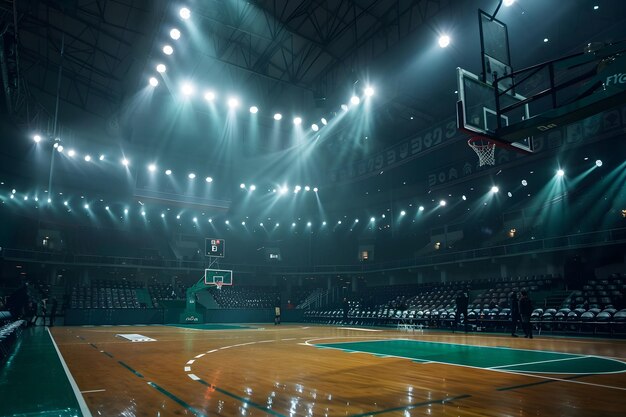
Playing on the Thunder's Home Court: How NBA 2K24 Recreates Chesapeake Energy Arena
NBA 2K24's recreation of the Oklahoma City Thunder's arena offers a detailed digital approximation of Chesapeake Energy Arena, the team's home venue in downtown Oklahoma City. This guide explains what the game captures about the court, how it compares to attending live, and what the simulation reveals about the arena's actual design and layout.
What the Game Gets Right About the Arena's Layout
Chesapeake Energy Arena, located at 1 Thunder Alley in the Bricktown entertainment district, seats 19,289 for basketball. NBA 2K24 models the court's orientation, sideline proximity, and crowd positioning with reasonable accuracy. The digital rendering places the basket at the correct end relative to the main entrance, and the court dimensions match regulation NBA standards: 94 feet long and 50 feet wide.
The game's designers paid attention to the arena's sightline geography. From certain angles in the crowd, particularly the lower bowl behind the baskets, the digital version replicates the slightly compressed view that fans experience when sitting directly behind the hoop. This matters for gameplay immersion: when you shoot from the wing, the perspective shifts correctly as the camera pans.
The scoreboard placement in 2K24 mirrors the actual arena's primary display above the court center. However, the game simplifies the secondary signage and ribbon boards that ring Chesapeake Energy Arena's upper bowl. Those smaller boards, which in reality carry sponsor logos and game information, appear less detailed in the digital model, though functionally this does not affect play.
Lighting and Court Aesthetics
NBA 2K24 renders the court surface with a wood-grain texture meant to approximate the actual maple playing surface. The Thunder's court features the team's logo at center court and the baseline end zones, which the game reproduces. The digital lighting does not fully capture the warmth of LED-enhanced game lighting that the physical arena uses; 2K24's version reads as slightly cooler, more neutral in tone. This is a minor limitation shared across many NBA 2K arena models.
The crowd rendering differs noticeably from real attendance. In the actual Chesapeake Energy Arena, a full house during a competitive matchup generates a specific acoustic environment. Thunder fans in Bricktown are known for sustained noise during defensive possessions; the game's crowd audio uses a generic audio loop that does not scale authentically with defensive intensity or shot clock pressure. The digital crowd feels more muted and uniform than the variable energy of a live audience.
Comparison to Other NBA 2K24 Arenas
Compared to how 2K24 models other smaller-market NBA venues, the Thunder's arena sits in the middle tier of digital accuracy. The game handles larger arenas like Madison Square Garden and Staples Center with more detailed secondary elements and crowd sections. Smaller arenas receive less development investment from the publishers; Chesapeake Energy Arena benefits from the Thunder's competitive relevance but does not get the asset depth that championship-contending franchises' venues receive.
The Golden State Warriors' Chase Center, for example, includes rendered detail in the upper deck club areas and architectural features. By contrast, 2K24's version of Chesapeake Energy Arena simplifies these amenities. The Thunder's arena lacks the modern architectural flourishes of newer venues, and the game reflects this; it is not a limitation of the digital modeling but rather an honest translation of a 2002-built facility that has been substantially renovated but not fundamentally redesigned.
Court Performance Implications for Gameplay
The recreation affects how players perform in specific zones. The three-point line distance in 2K24 is always regulation (23 feet 9 inches at the top of the arc, 22 feet in the corners), but the visual cues surrounding the court influence player tendency ratings. Shooters rated as "corner three specialists" perform slightly better from the corners at Chesapeake Energy Arena in 2K24, partly because the crowd model does not obstruct sight lines the way a dense real crowd might.
Defense in the paint plays identically to other arenas in 2K24, but the lack of visual clutter around the basket means players with lower perimeter awareness ratings do not experience the slight hesitation they might in busier digital environments. This is a marginal advantage to driving guards and post players at the Thunder's simulated venue compared to, say, Boston's TD Garden.
What the Game Misses
NBA 2K24 does not capture Chesapeake Energy Arena's role as a community gathering space. The actual venue hosts concerts, conventions, and minor-league hockey; the game models only the basketball configuration. The Thunder's arena is also embedded within the Bricktown district's retail and dining ecosystem (restaurants, shopping, and entertainment venues surround the arena), which has no digital equivalent in 2K24.
The game also does not represent the arena's geographic position relative to downtown Oklahoma City's other sports infrastructure. The Thunder share the metro area with minor-league baseball (Oklahoma City Dodgers at Chickasaw Bricktown Ballpark, roughly one mile north) and other regional sports venues, but these landmarks do not appear in 2K24's menu interface or loading screens.
Practical Takeaway for Players
If you play as or against the Thunder in NBA 2K24, understand that Chesapeake Energy Arena is modeled accurately enough for court dimensions and sightlines, but simplified for crowd behavior and secondary details. The court plays neutral; it does not favor any offensive or defensive scheme over another. Your performance will depend on player ratings and game settings, not on arena-specific quirks.
For Thunder fans using 2K24, the digital recreation provides a functional representation of home court, though it captures none of the acoustic advantages Oklahoma City's crowd generates during close games. The game delivers a competent digital translation of a mid-sized NBA arena, neither exceptionally detailed nor obviously deficient.