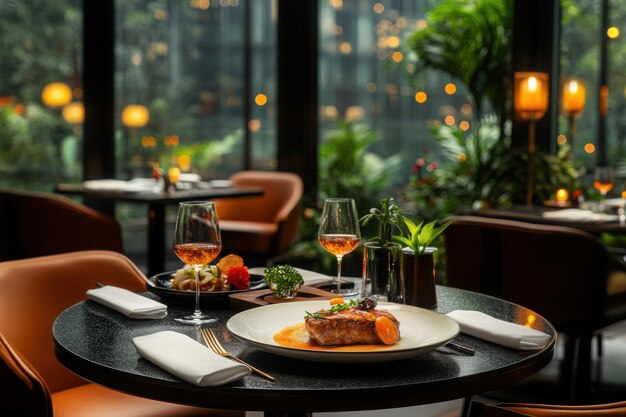
What to Expect from Nonesuch, the Pastry-Forward Restaurant in Midtown Oklahoma City
Nonesuch occupies a specific niche in Oklahoma City's dining landscape: a restaurant where the pastry program drives the menu rather than supporting it. This distinction matters because it changes what you're paying for and what skill set the kitchen is prioritizing. This guide explains how Nonesuch fits into the city's restaurant ecosystem, what to order, and whether the model works for your meal.
The Pastry-First Model and Why It's Uncommon Here
Most restaurants in Oklahoma City, even ambitious ones, treat pastry as a final course or a morning-only operation. Nonesuch reverses this. Pastry appears throughout the menu, not as decoration but as structural technique. This requires a different kitchen hierarchy than you'll find at most Midtown establishments, where the executive chef's primary training is typically in savory cooking.
The practical result: you're eating food built on laminated doughs, fermented bases, and sugar work before you encounter proteins or vegetables as primary components. A croissant isn't a side. Bread isn't a vehicle. This appeals strongly to diners who order dessert first and work backward, or who find the pastry course at other restaurants inadequate for their interest level.
Oklahoma City's restaurant market hasn't historically demanded this specialization. Places like Café Kacao in Midtown and The Red Cup in Bricktown serve strong pastries within a broader American or Mediterranean frame. Nonesuch abandons that compromise. The trade-off: if you dislike pastry, you're in the wrong restaurant, and no amount of menu flexibility will change that calculation.
The Menu Structure and Timing
Nonesuch operates on a prix fixe or tasting format, though specific pricing should be verified directly with the restaurant. This structure is common in pastry-forward kitchens because it allows the pastry chef to determine portion sizes and progression rather than letting individual diners order three desserts and call it dinner.
The progression typically moves from breakfast-style pastries and bread courses through savory applications of pastry technique (layered preparations, fermented elements, cured fish on laminated bases) before reaching explicitly sweet courses. This sequencing differs from traditional French tasting menus, where savory dominates and pastry concludes. Here, the endpoint might be a single, highly refined small sweet rather than an extended dessert course.
Service speed matters. A tasting menu built on pastry takes longer than a à la carte dinner because each element requires precision plating and precise temperature. Plan for 2.5 to 3 hours. This is not a weeknight restaurant for diners trying to catch a show at the Civic Center or heading to an 8:30 pm commitment afterward.
Ingredients and Sourcing Constraints in Oklahoma City
Oklahoma City has limited artisanal grain suppliers and virtually no commercial sourdough culture comparable to the Pacific Northwest or Northeast. This affects what fermented components Nonesuch can source locally. Most flour and grain products likely come from regional mills in Kansas or Texas, not from proprietary suppliers within the metro area.
This limitation is worth understanding not as a criticism but as context. Pastry-forward restaurants in places like Portland or New York operate with established supplier networks that Oklahoma City lacks. Nonesuch's sourcing decisions therefore reflect adaptation to regional availability rather than failure to meet coastal standards.
Dairy sourcing is stronger. Oklahoma and North Texas produce quality butter and cream. This shows in laminated doughs and custard-based courses, which are typically high points at restaurants working this direction.
Comparing to Other Upscale Dining in Midtown
The Loaded Bowl, also in Midtown, emphasizes locally sourced ingredients across a broader menu. Nonesuch is narrower in scope and more technique-intensive. If you want vegetables and grain as primary components, The Loaded Bowl serves that mission more directly.
The Wedge Pizzeria in Bricktown offers handmade pasta and house-made charcuterie, but pastry remains secondary. You're eating Italian kitchen priorities, not pastry kitchen priorities.
Pearl's Southern Bistro, on the northeast edge of the metro, works with classical French technique but maintains a balanced savory-to-sweet ratio. It's a different philosophical approach to technique than Nonesuch's specialization.
Scale this against your own interest level. Do you visit restaurants specifically to experience what the pastry program can do? Nonesuch serves that diner. Are you seeking a balanced meal with strong components across multiple disciplines? A different Midtown venue will suit you better.
Practical Considerations for Visiting
Reservations are essential. A specialized tasting menu restaurant cannot absorb walk-ins without destroying the pacing and consistency that justifies the format. Book at least two weeks in advance during peak season (fall and early winter). Call rather than relying on online reservation systems, which may not reflect real availability for tasting menus.
Dietary restrictions require early communication. A pastry-forward menu cannot easily accommodate gluten-free diners or those avoiding dairy, because pastry is fundamentally dependent on these ingredients. If you have genuine restrictions, call ahead and ask whether the kitchen can offer alternatives. Don't expect the answer to be yes; pastry-forward restaurants often cannot pivot this way without compromising their core mission.
Cost should be verified directly, as tasting menu pricing fluctuates with ingredient costs and seasonal changes. Expect to spend more per person than at The Loaded Bowl or Pearl's, and less than at fine-dining destinations outside Oklahoma City like The Ponca City-area resorts.
BYOB policies or wine programs vary. Call ahead to clarify whether wine pairings are offered, included, or prohibited. If you have a specific wine collection you want to bring, some restaurants charge corkage; others allow it freely. Neither is standard for tasting menu restaurants in Oklahoma City.
When Nonesuch Makes Sense
Book here if you eat pastry with intention, not habit. If your restaurant criteria include "strong bread program," "fermented components," and "technique visible in every course," you'll recognize why this restaurant exists and why it matters that it does.
Book here if you're in Midtown for an extended evening and want something that feels genuinely different from what you can access in other Oklahoma City neighborhoods.
Do not book here if pastry bores you, if you want to order à la carte, if you're hungry and need a quick meal, or if you're dining with someone whose preferences run entirely toward protein-focused plates.
The restaurant serves a real purpose in Oklahoma City's dining landscape. It's not better or worse than other Midtown restaurants; it's positioned for a different kind of diner.