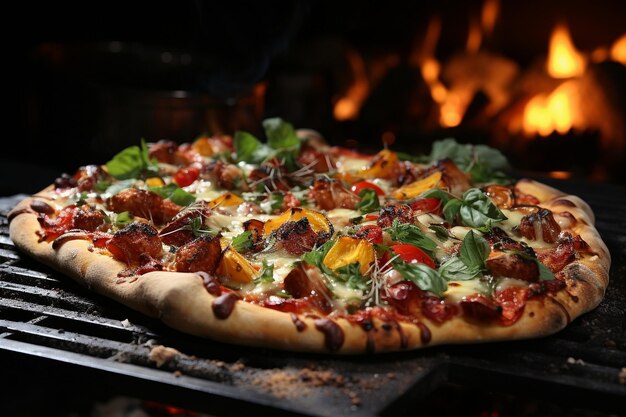
What to Order at Falcone's Pizzeria and Why Its Dough Method Sets It Apart in Oklahoma City
Falcone's Pizzeria occupies a specific position in Oklahoma City's pizza landscape: it operates a coal-fired oven on the south side and has built a reputation that draws customers willing to drive past closer alternatives. This article explains what makes the operation distinct, what the actual menu priorities are, and how it compares to the other established pizza makers across the metro.
The Coal-Fired Oven and Crust Philosophy
Falcone's uses a coal-fired oven, which operates at temperatures around 800 to 900 degrees Fahrenheit. This distinction matters because it changes how the dough develops and how toppings cook. In a coal oven, the crust blisters and chars in roughly 90 seconds. The high, concentrated heat means the inside stays soft and hydrated while the exterior develops a crisp, charred exterior. That speed also means less time for moisture to escape from the toppings, so vegetable pizzas tend to taste brighter than in conventional ovens where pies spend four to five minutes cooking.
The dough at Falcone's is proofed for multiple days, a practice that develops organic acids in the dough and changes how it browns. Fast-fermented dough (same-day or next-day) browns quickly but tastes more neutral. Multi-day dough develops a tangy undertone and a slightly more complex texture. This is a material choice, not marketing language, and you will taste the difference in the crust alone.
Menu Structure and Ordering Strategy
Falcone's operates a thin menu. Rather than 20 variations, expect roughly a dozen pies. The standard offers include a margherita (mozzarella, basil, sauce), a pepperoni, and several seasonal or house-created combinations. Specialty pies tend to rotate; this is normal for coal-oven operations because the wood or coal supply and ingredient seasonality drive what makes sense to feature.
The margherita should be the entry point. On a coal-fired pizza, this reveals the dough quality most clearly. There are no heavy toppings to obscure fermentation flavor or crust texture. If the dough tastes one-dimensional, the operation is likely not holding fermentation long enough or is using a weak starter.
Pepperoni pies at high-temperature ovens brown the pepperoni aggressively, sometimes to the point of blistering. Some customers prefer this; others find it too aggressive. The answer is to ask whether any pies use a lighter pepperoni application or a specialty cured meat that chars differently. If Falcone's offers a sausage pie, that's worth comparing directly to the pepperoni because sausage and pepperoni brown at different rates.
How Falcone's Compares to Other Coal-Fired and Conventional Operations Nearby
Oklahoma City has a small but measurable coal and wood-fired pizza presence. Falcone's is one of two or three such operations in the metro. Conventional ovens (which operate at 500 to 600 degrees over 10 to 15 minutes) dominate the mid-range pizza market across the city. The trade-offs are real:
Coal or wood-fired ovens produce a different crust character and require more skilled labor and more expensive equipment. They also take longer to preheat and require active management during service. A coal oven cannot simply turn on at 5 p.m. and turn off at 10 p.m. like a conventional deck oven. This means coal-fired operations tend to keep shorter hours or run a higher dough cost per pizza to offset the idle time.
Conventional ovens allow for higher volume, more consistent timing, and easier scaling. They also allow for a thicker, chewier crust if that is the house style. They do not produce the char and crispness or the fermentation-forward flavor of a multi-day dough in a coal oven.
Falcone's positioning is toward the craft end. It is not a commodity pizza operation. It is also not a Neapolitan purist (which would mean stricter ingredient sourcing and longer fermentation, often 48 to 72 hours). It is a middle ground: a coal-fired operation with modernized toppings and reasonable price point for that category.
Location and Practical Access
Falcone's operates on the south side of Oklahoma City. Distance matters if you are coming from Edmond, Norman, or the downtown core; travel time will add 20 to 30 minutes depending on where you start. This is relevant because fresh pizza does not travel well. In a car for 20 minutes, the crust will absorb some steam from the toppings and lose some crispness. If you plan to pick up, eat on-site or eat within five to ten minutes of pickup. If you are traveling more than ten minutes, order for delivery and expect a softer crust than what leaves the oven.
Hours typically run evening service only (dinner and late night). This is standard for coal-fired operations because daytime service does not generate the volume to justify the overhead. Verify current hours before driving; independent pizzerias sometimes adjust seasonally.
Price Context
Coal-fired pizza costs more than conventional pizza. Expect to pay 15 to 25 percent above the price of a comparable conventional pizza at a mid-range chain. At Falcone's, this is the oven, the dough fermentation time, and the ingredient cost. The margin on a $16 to $18 specialty pizza at a coal oven is lower than the margin on a $12 pie at a conventional shop that seats 80 people and does 150 pizzas on a Friday night. This is worth acknowledging upfront so price is not a surprise.
Individual (8 to 10 inch) pizzas should be available alongside larger formats. Individual pies cook faster and are useful for trying multiple varieties in one visit without waste.
What to Know Before You Go
Arrive hungry or come with an appetite to try two pies. One pizza alone may not be enough to evaluate the operation fairly. Eat one pie hot and fresh, then try something else. The fermentation and crust quality will be clearest on the plain margherita, so do not skip it. If the dough tastes soapy or overly sour, the fermentation may be too long; if it tastes slightly sweet and lacks complexity, it may be too short. You are tasting time, temperature, and flour quality.
The coal oven itself is usually visible or audible. It may be loud. Smoke will be present. If you are sensitive to wood or coal smoke indoors, ask about ventilation or seating location before you sit.
If you are comparing Falcone's to a conventional pizza place you already know, understand that you are not comparing the same product. You are comparing fermentation depth, crust texture, and char flavor against speed, consistency, and price. Both are legitimate choices depending on what you want in a meal.