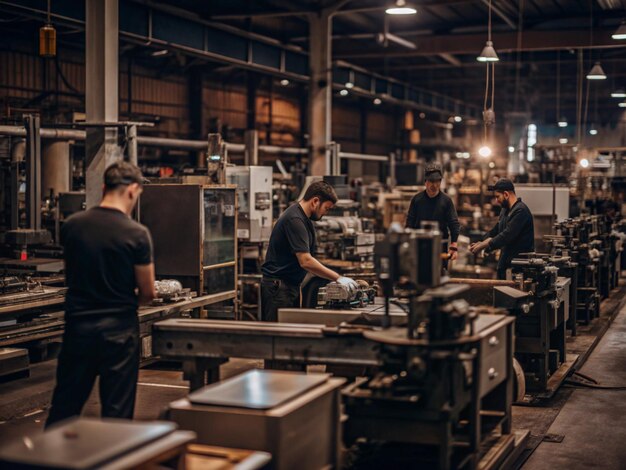
Contract Manufacturing and Made-to-Order Production in Oklahoma City
Oklahoma City's manufacturing sector operates largely outside consumer view, yet serves industries across the region and nationally. This guide covers what contract and made-to-order manufacturing looks like in OKC, who uses these services, how to evaluate providers, and what operational realities shape costs and timelines.
What Contract Manufacturing Means Here
Contract manufacturing means outsourcing production to a specialized firm rather than building in-house. The client provides specifications, materials, or designs; the manufacturer handles tooling, production runs, quality control, and often packaging. Made-to-order production is related but narrower: custom fabrication for a specific order rather than standing capacity.
In Oklahoma City, this work spans precision machining, sheet metal fabrication, plastic injection molding, assembly, and light industrial fabrication. Most shops serve B2B clients: other manufacturers, oil and gas service companies, HVAC distributors, agricultural equipment makers, and small product companies that lack production floor space or equipment capital.
The distinction matters because contract shops differ from job shops. A job shop takes one-off custom work. A contract manufacturer often runs the same product repeatedly for the same client, sometimes exclusively. This changes staffing needs, equipment investment, and pricing models.
Where Manufacturing Clusters in OKC
The city's industrial geography shapes which shops handle which work.
Midtown and near-downtown areas (roughly bounded by I-235, I-44, and Reno Avenue) host older, established machine shops and small fabricators. These typically run smaller batches and handle jobs requiring skilled machinists and quick turnarounds. Proximity to downtown's service businesses and downtown-adjacent warehouse districts means lower land costs than suburban industrial parks but also tighter spatial constraints.
The I-35 and I-44 interchange zone stretches west toward the Crossroads Industrial area. This corridor concentrates heavier manufacturing: metal stamping, larger fabrication shops, and assembly operations that need highway access and room for material storage. Rents and available acreage are higher than midtown but still lower than coastal industrial markets.
South Oklahoma City, beyond Will Rogers Airport, houses several large contract shops and food processing facilities. This district offers the most space for expansion and is preferred by manufacturers with high material throughput or those serving regional agriculture and energy sectors.
The choice of location affects your vendor's overhead structure, which translates to pricing and available equipment. A shop in midtown with 12,000 square feet operates differently from a 40,000-square-foot facility south of the airport.
Evaluating Providers: Five Key Criteria
Equipment and Capabilities
Start with what the shop can actually make. Precision CNC machining shops differ from press brake and shearing operations, which differ from plastic molding facilities. Review their machinery list: lathe sizes, press tonnage, mold inventory, testing equipment. A shop with five-axis mills can handle more complex parts than one with three-axis equipment. If your part requires tolerance control tighter than 0.005 inches, confirm the shop has CMM (coordinate measuring machine) capability and calibration records. Ask whether they hold tooling on-site or contract it out; if subcontracted, lead times stretch and quality control disperses.
Production Volume and Capacity
Clarify minimum order quantities and current capacity. A shop running at 85% capacity for other clients may quote long lead times or charge premiums for expediting. Ask about seasonal demand; OKC's oil and gas-linked manufacturers experience demand swings. If you need 5,000 units per month consistently, a shop designed for 2,000-unit batches will struggle. Conversely, a large shop with 50,000-unit-per-month capacity may refuse orders below 1,000 units or bundle them with other clients' jobs, delaying your delivery.
Quality Certifications and Testing
ISO 9001 certification is common and expected; verify current status. For aerospace, oil and gas, or medical applications, check for AS9100, API, or other vertical certifications. Ask what in-process inspections occur and how often. Some shops test first-piece samples only; better operations inspect every nth part or use statistical process control. Request documentation of their last third-party audit or quality audit results. If your parts feed into a safety-critical application, ask explicitly about failure rates from past production runs.
Lead Times and Price Transparency
Get written quotes that break out tooling costs, per-unit production costs, and non-recurring engineering (NRE) fees separately. Tooling costs are one-time charges that make small runs expensive but repeat orders cheap. A tool costing $8,000 amortizes to $0.80 per unit on a 10,000-unit order but $8 per unit on 1,000 units. Ask whether the quote includes setup charges and how many setups are included. Some shops charge per setup after the first; others bundle unlimited setups. Lead time should account for material procurement, not just shop floor time. A six-week quote with a four-week material lead time means you wait six weeks regardless, not ten weeks total.
Communication and Problem Resolution
Speak to someone technical during the quoting process, not just sales. A good shop will ask clarifying questions about your drawing, material choices, and application. Ask how they handle scrap or defects. Do they remake parts at no charge, or does your order cover scrap allowance? If production goes wrong mid-run, do they notify you immediately or deliver and report problems afterward? Request a reference from another client in your industry; call them and ask about responsiveness and how the shop has handled issues.
Cost Structure Realities
Pricing in OKC contract manufacturing does not vary wildly among shops, but contract terms do.
Labor rates for skilled machinists in Oklahoma City run lower than Midwest industrial hubs like Ohio or Indiana, typically 15 to 25 percent below those markets. This advantage partially offsets OKC's distance from coasts for some clients. Material costs are neutral; steel and aluminum prices are national commodities. Tooling costs depend on complexity; a simple 2D stamping tool costs less than a multi-cavity injection mold, which costs less than a complex multi-axis machined fixture.
Your actual per-unit cost depends on lot size. A 100-unit order of machined parts might cost $50 per unit; the same design at 5,000 units could drop to $12 per unit if tooling spreads across the volume. This is why contract manufacturing makes sense for companies that cannot justify in-house capability but need scale savings without fixed asset burden.
Setup and changeover costs matter. A shop running your job immediately after a compatible job (similar materials, similar processes) charges less than one that must completely retool. Ask where your job sits in the current schedule.
Red Flags and Verification
If a quote seems unusually low, ask why. Legitimate reasons include recent equipment investment reducing shop overhead, low current utilization, or material volume discounts you didn't request. Illegitimate reasons: corners cut on inspection, inexperience with your part type, or underbidding to lock in later change orders.
Verify certifications directly with issuing bodies when stakes are high. Some shops claim certifications they've let lapse. Check the ISO registry or the AS9100 registry online.
Ask for a sample or production proof from a similar past job. If the shop resists, that is a signal.
Next Steps
Request quotes from three shops with different equipment profiles. Frame your inquiry clearly: part drawing or description, annual volume need, material preference, tolerance requirements, and target price per unit. Allow at least two weeks for response; shops do not hold sales staff for rapid callbacks. After you receive quotes, visit the finalists in person. A facility tour tells you more than a phone call about organization, cleanliness, and how seriously they treat client work.
Choose based on fit, not lowest price alone. The cheapest shop that misses deadlines or quality targets becomes expensive quickly.