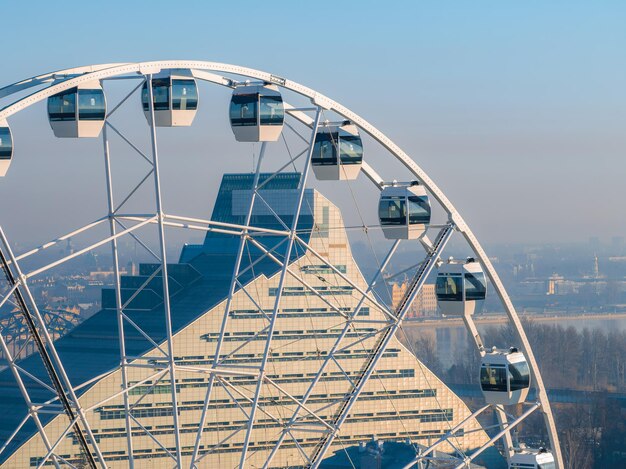
The Ferris Wheel at Myriad Gardens: What to Expect and How It Fits Oklahoma City's Waterfront Arts District
The 75-foot observation wheel at Myriad Gardens in downtown Oklahoma City operates as both a working piece of recreational infrastructure and an inadvertent landmark in a neighborhood still defining itself as an arts destination. This guide covers what you'll experience riding it, how it compares to other Oklahoma City attractions in the same price tier, and whether the vantage point justifies the cost for different visitor types.
The Ride Itself
The wheel sits within Myriad Gardens, a 17-acre mixed-use development bounded by Robinson Avenue and Reno Avenue in the Bricktown-adjacent core of downtown. Each of the 36 enclosed gondolas holds up to six adults comfortably. The ride cycles continuously; you don't wait for a full load. Each rotation takes roughly 12 to 15 minutes, giving you time to photograph the downtown skyline and the adjacent Oklahoma River corridor without the clock-watching pressure of faster rides.
Unlike regional counterparts such as the observation decks at tall hotels or viewing platforms at state parks, the Ferris wheel offers a moving platform. This matters if you're documenting the view or sitting with someone who struggles to stand still during sightseeing. The wheel doesn't stop between rotations, so boarding requires minimal agility but does happen in motion at walking pace.
The wheel operates year-round. Summer months (June through August) can reach the mid-90s Fahrenheit, and the gondolas have air conditioning but no windows you can open. Winter temperatures rarely drop below freezing for extended periods, though wind chill at 75 feet is noticeably sharper than ground level. Spring and fall offer the most comfortable riding conditions.
Admission and Logistics
Tickets cost $12 for adults and $8 for children ages 3 to 12 as of 2024 (verify current pricing at myriadgardens.com or the on-site booth). Children under 3 ride free. This positions the wheel between casual activities like a walk through the Paseo Arts District ($0, though you'll spend money at galleries and cafes) and ticketed attractions like the Oklahoma City Zoo ($22.95 adult admission).
Operating hours are 10 a.m. to 10 p.m. most days, with slightly extended hours during summer months. The wheel closes periodically for maintenance; high winds sometimes trigger temporary shutdowns, particularly in spring. Unlike indoor attractions, you're weather-dependent.
The wheel sits steps from River North, a developing neighborhood with young restaurants and galleries around the Myriad Gardens complex. Parking is available in the Myriad Gardens lot or at nearby meters; validated parking is available if you purchase food or drinks at venues within the complex.
What You'll See and Why It Matters
From the wheel's highest point, the view covers the downtown skyline to the north (Bricktown, the Skirvin Hotel, Chesapeake Energy Corporation offices), the Oklahoma River and Boathouse District to the south and east, the Stockyard City area to the southwest, and the Capitol Hill neighborhood to the west. The Arts District itself (along NW 23rd Street, several miles north of the wheel) is not visible from this vantage.
If you're evaluating your options for a high-altitude Oklahoma City view, this wheel offers a different perspective than the Observation Deck at Devon Tower (45 stories, downtown, $15 admission, indoor and controlled) or driving to the top of the Skirvin (limited observation areas, free for hotel guests). The Ferris wheel gives you a 360-degree rotating view without entering a building, and it's specifically calibrated for casual photographers and families rather than high-altitude enthusiasts seeking extreme height.
The river view is the draw that distinguishes this from generic ferris wheels. The Oklahoma River development, including the Boathouse District, has become central to how Oklahoma City markets itself as a waterfront city. The wheel lets you see this infrastructure—the rowing facilities, the water taxis, the landscaped parks—all at once, which reinforces the narrative the city is constructing around the river corridor.
The Arts & Entertainment Context
Myriad Gardens itself hosts seasonal outdoor performances and art installations. The wheel is not an art installation and was not designed as one, but it functions within a site that treats itself as a cultural venue. Visiting the wheel as part of a larger Myriad Gardens afternoon (browsing the Crystal Bridge Tropical Conservatory, checking event schedules, eating at one of the restaurants in the complex) makes the ticket cost feel less isolated. A wheel ride alone, 15 minutes and $12, feels thin if that's your only interaction with the area.
The wheel opened in 2013 and has become a predictable fixture rather than a novel attraction. It draws families, tourists passing through, and date-night couples who pair it with dinner. It does not draw arts audiences specifically. If you're in Oklahoma City for museums, galleries, or performance, the wheel is an optional activity during downtime, not a primary draw.
Practical Decision Points
Ride the wheel if you want a rotating view of downtown and the river without committing to an indoor observation deck, or if you're visiting with children under 12 (the ticket is cheaper and the gentle motion appeals to younger riders). Skip it if you've already seen Oklahoma City's downtown from ground level and don't need a helicopter-level confirmation of the view. Don't ride it at midday in summer unless you're heat-tolerant; mornings and evenings are more comfortable.
Budget 30 minutes total (including parking and buying tickets) if you're stopping by. If you're spending the afternoon in River North or Myriad Gardens, the wheel functions as a natural break activity rather than a destination unto itself. Bring your phone charged for photos; the view is the main takeaway.